

When India’s first Prime Minister Jawaharlal Nehru visited the deliberate web site of the Bhakra Nangal Dam in Bilaspur in 1954, he known as dams “the temples of modern India”. Contained in his flip of phrase had been many indications about the way in which India was to develop within the coming a long time – nevertheless it additionally spoke to the centrality of electricity within the fashionable nation and the foundations that energy transmission laid for financial growth.
This article presents a simplified introduction to electrical energy transmission.
Why transmit energy?
Since power exists in lots of types, like mild, sound, warmth, and so forth., energy and energy transmission additionally exist in lots of types. For instance, mechanical energy in a automobile is transmitted utilizing gears. Electric energy transmission is extra difficult due to the a number of phases of electrical present, and components like voltage, impedance, frequency, and so forth.
Any energy provide system has three broad parts: technology, transmission, and distribution. Electricity is generated at energy vegetation in addition to smaller renewable-energy installations. Then it is transmitted utilizing a distributed community of stations, substations, switches, overhead and underground cables, and transformers, amongst different parts.
Finally, it is distributed to customers in a standardised approach, befitting the wants of assorted machines and functions.
What are the fundamentals of transmitting electricity?
First, in any conductor that transports electrical present, the transmission effectivity is greater at decrease present and better voltage. This is as a result of the power loss throughout transmission will increase because the sq. of the present, whereas the quantity of voltage enhance corresponds on a 1:1 foundation with the quantity of present decreased. That is, if voltage is elevated by 5 models, the quantity of present will drop by 5 models, however the quantity of power misplaced can be diminished by 25 models.
This is the aim of transformers: they enhance the voltage and cut back the present earlier than feeding into transmission strains, and the reverse when receiving present to be provided to customers. Transmission cables could be seen transporting present at 115 kV, 230 kV, and so forth. for that reason. However, greater than 2,000 kV or so is infeasible as a result of then air itself turns into conducting, inflicting the cable to ‘leak’ present.
Three transformers seen at Keilor Terminal station, Melbourne. The transformers change between 220 kV and 66 kV.
| Photo Credit:
Allalone89, public area
Second, the cables that transfer the present nonetheless have some resistance, which ends up in some power loss. The quantity of loss could be managed by adjusting the cable’s thickness: the thicker it is, the much less power is misplaced, however the fee will increase. So when the commodity price of the cable’s materials is excessive, the cables are thinner.
Third, the longer the gap of transmission, the decrease the transmission price.
All these components are additional difficult by way of alternating present (AC). AC could be modified extra simply in transformers than direct currents (DC) and likewise has greater transmission effectivity. But when the AC frequency is greater, the quantity of resistance the present encounters within the materials will increase.
Engineers mannequin all these components for a given community to know how a lot electrical power can be misplaced between technology and consumption.
What is AC energy?
The commonest method to switch electrical energy is within the type of three-phase AC. In AC, the voltage flips polarity. If one polarity urges the present to movement in a single path, the other polarity urges the present to movement the opposite approach. The AC frequency is equal to the voltage flipping frequency.
Imagine this voltage change to be mapped to a circle: it completes one semi-circle (180°), from prime to backside, because it flips a technique; when it flips the opposite approach, it completes the opposite semi-circle (180°) and is again to its place to begin.
In a three-phase AC circuit, there are (at the least) three wires. When present begins to observe in Wire A, the voltage is at 120°; in Wire B, it is 240°; and in Wire C, it is 360°. These are the three phases.
All three wires transport AC energy. Consumers, for instance households, obtain three such wires from the place they’ll draw energy for varied home equipment. These home equipment are additionally designed to make use of AC as a result of it is simpler to manage than DC.
How is energy transmitted?
In a three-phase AC circuit, every wire transmits an AC present in a unique section. From an influence station, the wires are routed to transformers that step-up their voltage. Then, they’re suspended from transmission towers, which should be secure and correctly wired, as they journey lengthy distances.
Insulators involved with the wires draw away some present if there is a surge within the line; circuit-breakers ‘break’ the circuit if there is an excessive amount of. The towers are additionally grounded and geared up with arresters that forestall sudden will increase in voltage – comparable to attributable to a lightning strike – from affecting the wires. Similarly, dampers forestall vibrations within the wires from affecting the towers’ stability.
Switches are used to manage the provision of present and to maneuver currents between completely different strains.
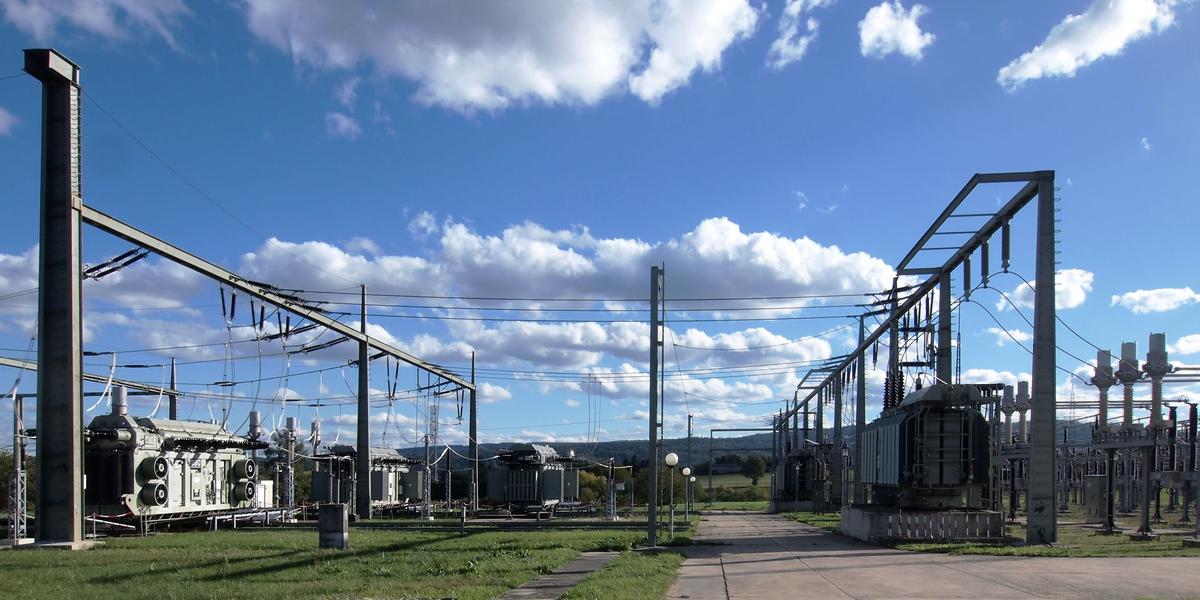
A view of a substation in Pforzheim, Germany, that switches voltages between 220 kV, 110 kV, and 20 kV, October 2016.
| Photo Credit:
Ikar.us (CC BY 3.0)
These wires ultimately result in and exit from completely different sorts of substations. For instance, collectors gather energy incoming from completely different sources and relay them to transmission substations. Converters modify the AC frequency. Distribution substations step-down the voltage in energy strains and put together them for consumption. Transmission substations merge or fork completely different strains and diagnose issues in several strains.
All these centres require their very own help and security infrastructure, from electrical engineers to fireside safety, from connections to computerised operations to amenities for workers. There are additionally many different parts and setups to carry out varied different features, in step with the subtle wants of whole financial areas.
How do grids function?
As talked about earlier, transmission is located between manufacturing and distribution. A nationwide grid contains all three parts, and consequently transmission additionally has to account for the particulars of energy manufacturing at several types of sources, at varied places, and the way and the place that energy is consumed.
For instance, some sources – like coal-fired or nuclear reactors – can produce power repeatedly, whereas renewable power sources are intermittent. So grids even have storage amenities that retailer electrical power when there’s a surplus provide and launch it in occasions of deficit. They are additionally linked to sources like gasoline generators that may present energy on brief discover, comparable to throughout emergencies, in addition to automated techniques that ‘tell’ sources to extend or lower their output in response to fluctuating client demand.
Grids additionally want to reply to failure in several components of the community and stop them from carrying over to different components, alter voltages in response to demand (in addition to handle demand), management the AC frequency, enhance the ability issue (the ability drawn by a load versus the ability obtainable in a circuit), and so forth.
A grid turns into a wide-area synchronous grid if all of the turbines linked to it are producing an AC present on the identical frequency. The world’s largest such grid covers Azerbaijan, Belarus, Georgia, Kazakhstan, Kyrgyzstan, Mongolia, and Russia; the world’s strongest is the North Chinese State Grid, with a linked capability of 1,700 GW. India’s nationwide grid is additionally a wide-area synchronous grid.
Such grids end in decrease energy price but in addition require measures to forestall cascading power-supply failures.