

Bumblebee (Bombus festivus) specimens from high-altitude areas of Arunachal Pradesh within the NCBS museum in Bengaluru.
A museum at National Centre for Biological Sciences (NCBS) in Bengaluru has began to put collectively a group of bees from across India, notably biodiversity hotspots resembling Western Ghats and North-east India.
According to NCBS, whose scientists are a part of a worldwide collaboration to chart a road-map to take Asian bee research ahead, “The lack of knowledge about where and how bee species live, and even more foundationally, an inability to identify different species is the biggest impediment to the conservation of Asian bees. This is the case in India too, where very little is known about the species’ diversity, population trends and the behavioural traits of native bee species.”
In order to refill this lacuna, the museum has began to put collectively a group of bees.
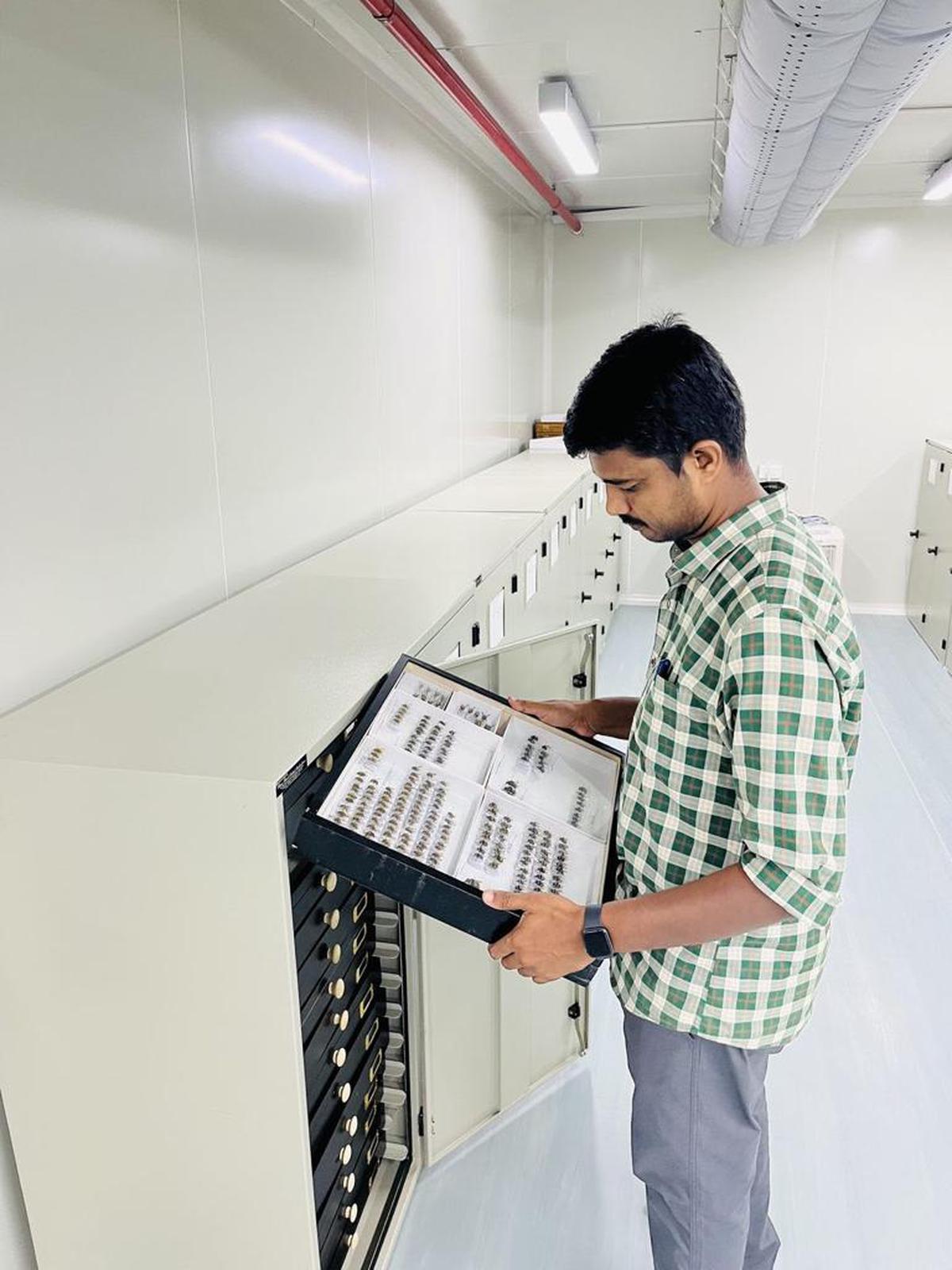
H.M. Yeshwanth (museum facility In-charge) informs that the power in Bengaluru is local weather managed and one among its sort in India.
H.M. Yeshwanth, answerable for museum and collections, mentioned, “We have specimens from all the different honey bee species, including the giant honey bees Apis dorsata, Apis laboriosa, Apis binghami and Apis breviligula. Of the four, A. laboriosa is particularly a spectacular species, in large part because it usually nests on inaccessible cliff crevices in the Himalayas.”
In addition to honey bees, additionally they have a singular assortment of 1,200 bumble bee specimens belonging to 24 completely different species from North-East India, collected by NCBS scientist Axel Brockmann and his collaborators from Germany, and the Rajiv Gandhi University in Arunachal Pradesh.
Climate managed facility
The facility is local weather managed and is one among its sort in India. It is a nationwide repository of dry and moist specimen collections. It additionally gives taxonomic experience to assist establish and classify species.
In addition to the museum, 74 authors, together with three NCBS scientists dwelling and dealing in 13 Asian international locations and past, have come collectively to chart a roadmap for Asian bee research.
Their research paper — titled Opportunities and challenges in Asian bee research and conservation — recommends extra assets be put into constructing fundamental information of bee biodiversity in India and Asia.
Ecological research advocated
Alongside constructing upon these efforts, additionally they advocate finishing up ecological research at each nationwide and regional ranges, to higher perceive how pollinator communities and their ecosystem companies will be maintained.
According to NCBS, Asia hosts 15% of the world’s bee species, however only one% of the worldwide public information on bee distribution represents the area. Bees pollinate almost 35% of our meals crops, thus offering important ecosystem companies which can be essential for our meals safety. With over half the world’s human inhabitants residing in Asia, reaching meals safety within the area is a significant problem, particularly as modern habitat loss and world local weather change proceed at an unprecedented price.